



Choosing between overdenture or fixed prosthesis is one of the most common doubts for those who need to replace one or more missing teeth. Both solutions allow the recovery of chewing function and aesthetics, but they meet different needs for stability, daily management, and long-term expectations.
Knowing the differences between fixed prostheses and overdentures helps to approach this choice in a more informed way.
What is overdenture
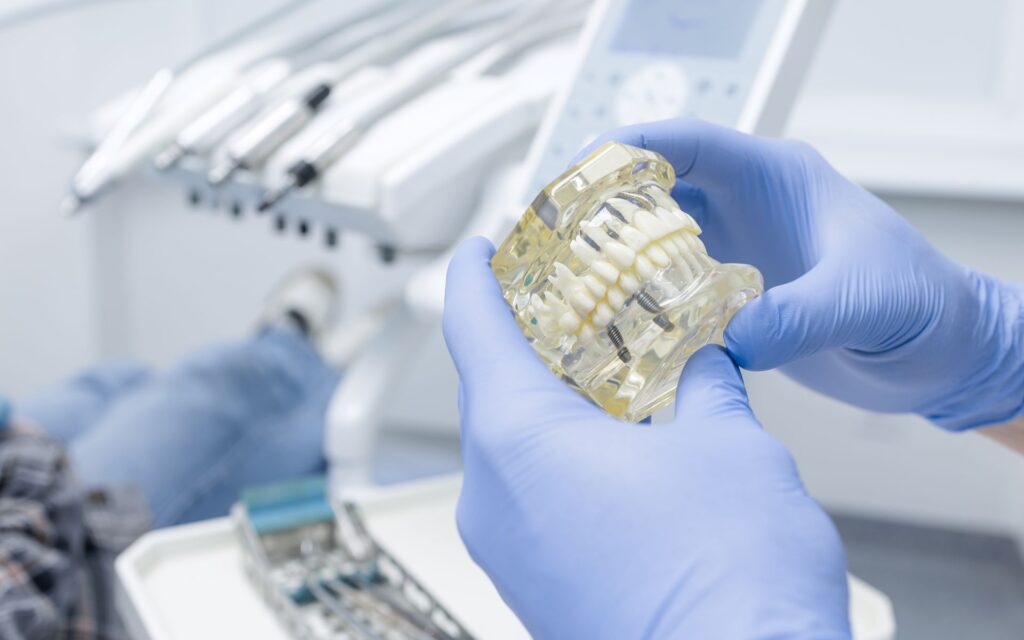
L’overdenture is a type of removable prosthesis consisting of two main elements: an implant (artificial titanium root) placed within the bone, which serves as a stable support, and a removable prosthesis, which attaches to the implant via dedicated anchoring systems, allowing it to be easily removed for cleaning.
Overdenture can be achieved in two main ways:
- On residual natural teeth, using the roots of still healthy elements as support
- On dental implants, with or without an artificial palate
What is fixed prosthetics on implants
Fixed prosthesis is a stable and permanent solution attached to implants placed in the bone. It is designed to ensure high strength and as natural a perception as possible in daily life.
Depending on clinical needs, it can be:
- Screwed down, so only removable by dentist for checkups and maintenance
- Cemented, permanently fixed with dental cement
Overdenture or fixed prosthesis: main differences and advantages
The choice between overdenture and fixed prosthesis depends on the functional needs, daily habits and clinical condition of the patient.
It is good to specify that both solutions allow you to return to chewing, smiling and speaking with confidence. However, they present different characteristics that it is important to know in order to identify the most suitable solution for your case.
Stability and chewing
→ The overdenture provides high stability through implant attachments, ensuring safe and comfortable chewing. Although slightly mobile compared to a fixed prosthesis, this mobility is controlled and does not compromise daily experience.
For many patients, especially those accustomed to traditional dentures, this represents a great improvement without complex interventions.
→ Fixed implant-supported dentures provide the highest level of stability achievable, as it is screwed or cemented onto the implants and is not removable by the patient. This feature allows a feeling very similar to that of natural teeth, especially during chewing, making it ideal for those who want maximum comfort and a natural smile.
Daily hygiene
→ One of the main advantages of theoverdenture is that it can be removed, making it easier to clean, especially in elderly patients or those with reduced dexterity.
→ Fixed prostheses while providing excellent stability, on the other hand, require more thorough cleaning with dedicated instruments, as well as regular checkups at the dentist.
Treatment time and complexity
→Overdenture generally requires fewer implants, with simpler operations and faster healing time, preserving bone.
→ Fixed prosthetics requires more elaborate planning and longer osseointegration times, however, compensated by a definitive and stable result over time.
To whom the overdenture is addressed.
Overdenture is an intermediate solution: more stable than removable dentures (traditional dentures) and cheaper than fixed implant-supported dentures.
It is particularly suitable for:
- Elderly patients, already accustomed to the use of traditional dentures, who want an equally practical but more stable solution
- Those who have limited amounts of bone, because they may require fewer implants than a fixed prosthesis
- Patients seeking a less invasive implant pathway with shorter treatment times and lower costs
- Those who want a prosthesis that is easy to remove and manage every day, without the use of adhesive glues, with a greater feeling of comfort, safety and freedom in daily gestures
Thus, the overdenture combines practicality and stability with good aesthetics. However, while it is very versatile, only a personalized dental evaluation can determine whether it is the most suitable solution for the individual patient.
Fixed prosthetics: the choice for those seeking maximum comfort
Fixed prostheses are often chosen by those who wish to forget about having a prosthesis and seek especially:
- maximum stability
- chewing as natural as possible
- high-level aesthetic result
Treatment requires thorough clinical evaluation, careful planning, and regular professional maintenance, aspects that should be carefully considered together with the specialist.
Overdenture or fixed prosthesis: which to choose?
There is no one-size-fits-all answer. The choice between overdenture or fixed prosthesis depends on several factors, including:
- quantity and quality of available bone
- age and general health condition
- Manual dexterity and autonomy in daily management
- aesthetic and functional expectations
- budget available
Only an individualized clinical assessment can identify the most suitable solution, taking into account not only the mouth, but also the lifestyle and the patient’s real needs.
An informed choice, to be made with expert support
Both overdentures and fixed prostheses are viable and effective solutions.
Relying on an experienced professional allows you to truly understand the pros and cons and face the journey with greater peace of mind, knowing that you have chosen what is truly best for you.
Book a specialist visit and find out if overdenture or fixed prosthesis is the solution for you