




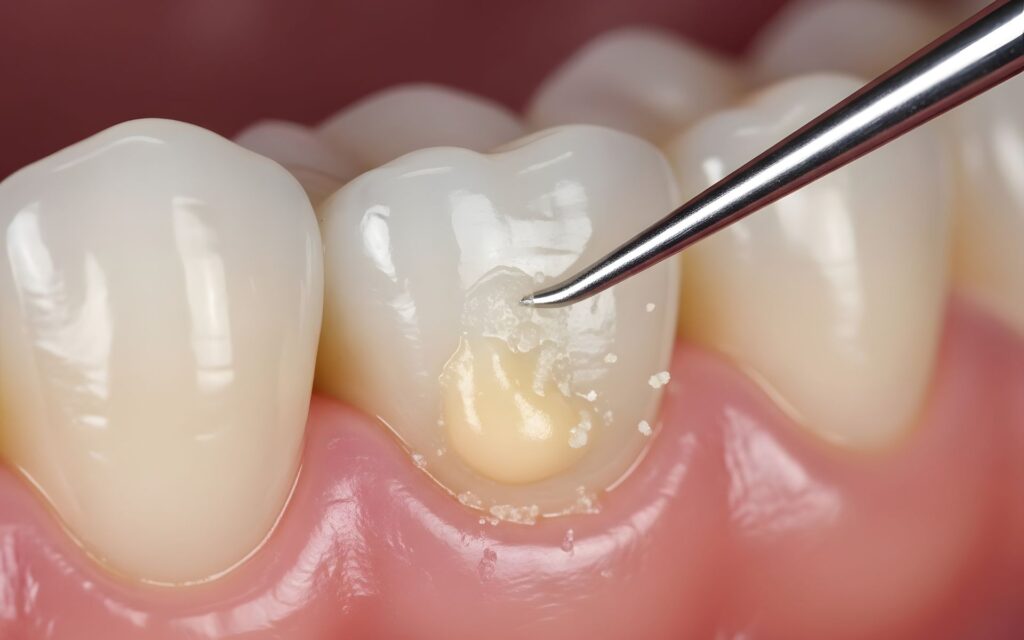
Tartar ablation is one of the most common treatments in dentistry and is essential for maintaining healthy teeth and gums over time.
Many people believe that proper oral hygiene is limited to brushing and flossing. However, even with thorough brushing, it is impossible to completely remove plaque in hard-to-reach areas. When plaque hardens, it turns into tartar, which cannot be removed by simple brushing.
At this point, a professional dental cleaning is essential to remove tartar and prevent complications such as gingivitis, tooth decay, and other oral diseases.
What exactly is tartar ablation (or scaling)
Tartar ablation, also known as scaling, is a professional dental hygiene treatment to remove tartar deposits accumulated both above and below the gum line.
Tartar is nothing more than bacterial plaque that, in contact with the mineral salts in saliva, hardens into a kind of calcified “armor.”
How tartar forms and why it cannot be removed at home
Tartar formation is a progressive and natural process: plaque accumulates, then mineralizes, then turns into tartar.
Some factors can also accelerate it:
- oral hygiene not always effective
- diet rich in sugars or pigmenting substances
- individual predisposition
Unlike plaque, which is soft and can be removed even at home with a little precaution, tartar once hardened adheres tenaciously and stably to enamel, and only professional tools can remove it. Trying to remove it yourself is impossible, as well as risky.
Removing tartar: here’s why your mouth will thank you
Regularly undergoing a professional hygiene session means investing in the longevity of your teeth.
In fact, eliminating these deposits allows you to:
- Have stronger gums: no more redness or uncomfortable bleeding
- Prevent cavities by eliminating the “reservoirs” of bacteria that attack enamel
- Freshen breath: halitosis is often caused precisely by bacteria embedded in tartar
- Maintain natural whiteness by eliminating surface stains caused by food and smoke.
What happens if we put off tartar ablation too long?
Ignoring tartar buildup is never a good idea.
Over time, in fact, they may arise:
- Gingivitis and periodontitis, which in the long run could affect the stability of teeth
- tooth decay and chronic halitosis
- issues even on dental implants
All conditions that can be prevented with regular checkups and professional hygiene sessions.
How a tartar ablation session works
Tartar ablation is performed in the office by a dental hygienist or dentist.
Specific tools are used during the session:
- Ultrasound, which removes tartar quickly and gently
- Hand tools, for finishing the most difficult areas
- lastly, the teeth are polished to remove surface stains and make the surface smoother, so as to slow new plaque deposition.
The treatment affects both the visible part of the tooth and the areas under the gum, where bacteria often accumulate.
Does tartar ablation hurt? What to expect during the session
This is obviously one of the most common questions.
In most cases, tartar ablation is not painful, but it can cause mild discomfort, especially with sensitive or inflamed gums.
Sensitivity varies from person to person, but today all techniques are available (including mild local anesthesia if needed) to make the session absolutely comfortable.
Timing and frequency: how often should tartar ablation be done?
A session lasts an average of 30 to 60 minutes, depending on how much tartar has accumulated and the patient’s gum situation.
As for frequency, it is generally recommended that you have a scaling session every 6-12 months. However, your hygienist will recommend the ideal cadence based on your gum health and the rate at which your body produces tartar.
What to do after the session to make the result last
After a tartar ablation session, mild sensitivity may be experienced, which is expected to disappear in a short time.
To maintain the benefits over time is useful:
- Wait at least one hour before consuming pigmenting foods or drinks (e.g., coffee, red wine, licorice)
- continue with proper daily oral hygiene
- Follow the directions received in the study and schedule periodic checkups
Protecting your smile is a team effort: the dentist cleans where you don’t reach, but it’s your daily actions that make the difference. Teaching these habits to even the youngest children is the best gift you can give to their future health.
Ablation or bleaching: let’s have clarity
These two treatments are often confused, but they actually have different goals.
→Tartar ablation removes tartar and surface stains and restores natural tooth color.
→ Professional teeth whitening, on the other hand, acts on the color of enamel to make teeth whiter.
The two treatments are complementary and can be combined to improve the health and aesthetics of the smile, such as by integrating a treatment of:
Your dental hygiene at Centri Dentali Zanardi